“How am I supposed to see this thing on the water?” I asked.
“You’re not,”was the reply.“If you see a rise within three feet of where you think the fly is, lift the rod.”
“Three feet,” I laughed. “Good one. Seriously, how’s this work?”
“Just start casting.”
I grew up with bass on Canandaigua Lake, and growing up with bass meant pitching lures with some backbone. Minus-4 crankbaits and 6″ Senko’s, rattletraps and double-bladed spinnerbaits. Daredevil and Cleo spoons. It was impossible to pursue fish in brush-covered cut-banks, stump fields and blowdowns like I did with insufficiently burly lures.
It only made sense that when I first started chasing fish with a fly rod, more often than not, big flies were my go-to.2/0 Deceivers and crease flies. Lead-bellied crayfish patterns and deer-hair poppers the size of fieldmice. Flies with substance and mojo.
I liked the aggression big flies attract from fish. Torpedoes from submerged logs or weed beds crashing the surface, brawling like someone was trying to take their lunch. Even small fish were tough. They punched well above their weight, and when returned to the water, swam back and bragged to their buddies about how they’re not going to take crap from the pickerel anymore.

But truth be told, any fish on the thin end of a fly line has got his jaw set for the next bend, valley or other end of the lake, regardless of fly size. A fight’s a fight.
And so it was I went to the Cohocton River for the first time to fish for browns and rainbows with flies much smaller than I was used to casting. I wanted to learn, and a friend of mine was willing to broker the introduction. We hiked our way to a likely stretch of water and got to work.
He supplied the flies. Size 22 and 24 black gnats. I supplied the doubt that they could hold enough meat to keep a fish hooked. I had heard of big fish, over twenty inches, caught on flies size 20 or smaller. Catches like that ran counter to my run-and-gun belief in big flies/big fish. I had trouble comprehending what use a bruiser would have for a fly that’s roughly the size of four grains of sand. I knew I wasn’t going to face any twenty-inch fish in the Cohocton, but fifteen inches was a possibility. And a fifteen-inch trout on a tiny fly is more than enough to test your mettle.
Unlike the hefty alternative, casting small flies takes stealth and finesse. Blind casts to mid-current pockets. Invisible drifts through steady rises. Guestimates and shots in the dark. An effortless delivery that drops the fly on the surface like a whisper.
After several hundred casts, I had snapped at least a dozen flies off the line like a bull-whip crack. Whoo-tish! My big-fly muscles were slow to ease up.
After several hundred more casts the flies stopped taking their freedom-flights into the woods and brush that lined the banks and started finding my aiming points. They landed on the surface more like mumbles than whispers, but I had found a modicum of stealth. I started stalking runs and riffles and pools as purposefully as a gun dog on a bird.

I laid a cast up and across the current to a slick stretch along the far bank, choked with overhanging brush. Miraculously, the fly avoided the brush and touched down gently on the water. The drift was right. I held my breath.
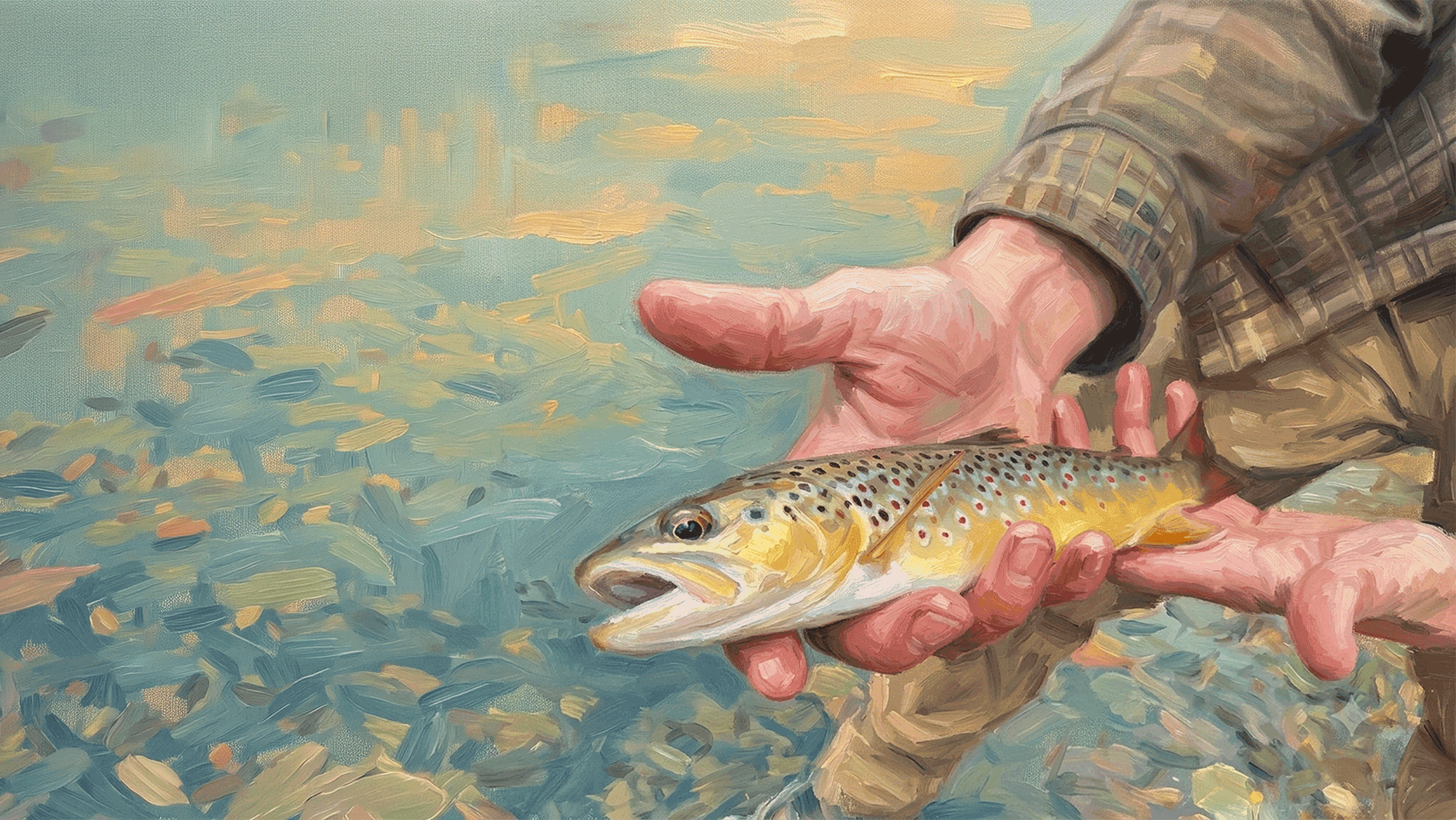
The rise was unremarkable. Not much more than a dimple that a raindrop might make. But when the line went taut as I lifted the rod, oh man, that fish ran like he stole something. The gnat stayed put and after a minute or two, the fish settled into my hand. A cold, sleek stick of red-spotted butter-brown dynamite.
Kneeling in the shallow water near the shore, the brown in my hand introduced me to an aspect of fly fishing that has deepened my appreciation time on the water. I had never slowed down and paid attention to the little things that make the big things possible. The individual bends and riffles, and pools that make up the river. Brush-lined banks that lead to thickets that climb steep hills that shoulder these valleys. A few quiet hours spent with my friend and the lifelong change in perspective I gained. The small bugs that feed big fish.
Matt Smythe is a writer, lifelong outdoorsman, and Army veteran hailing from the Finger Lakes Region of Western NY. He’s the author of Revision of a Man (2022) and forthcoming novels, Letters to Trout Fishing in America (’27) and Dead Stars (’28). Matt’s writing has appeared in Gray’s Sporting Journal, the Fly Fish Journal, The Drake, Southern Culture on the Fly, TROUT, Free Range American, Coffee or Die, POST Magazine, and other anthologies and literary journals. You can find his work at mattsmythe.com and on Substack at Glorious Mayhem.