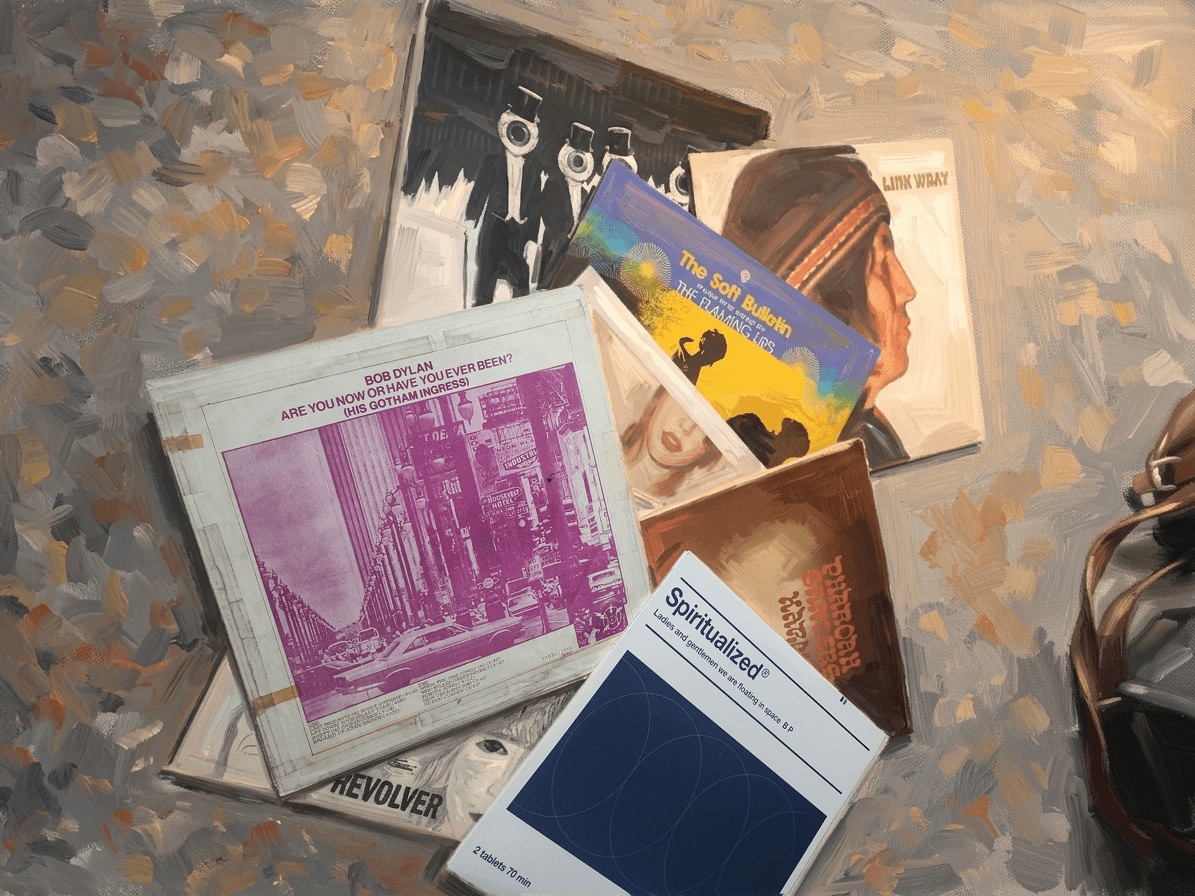
I started buying used records around 1999, between middle school and high school. It was not a hipster move. Our internet on the ranch was painfully slow. I set up Napster downloads before catching the bus so that when I got off I could burn low fidelity MPEG-1 Audio Layer 3 files onto rewritable compact discs. This was indeed a lot of effort. For a teenage boy, though, it was definitely the second coolest thing about the Internet.
My hometown record store had two dozen unorganized crates of records under the CD bins. These were mostly trade-ins from people jumping to the new, digital formats that promised greater resolution, portability, and ease of use. Every album was a potential discarded treasure. Digging through those dusty taped up boxes, I didn’t know how little I knew, what classics and rare discs I must have surely missed. Oh well.
Nostalgia is not where I am going with this, though. What interests me is the steady and surprising rebirth of vinyl records and how a new generation of music lovers are opening, literally and figuratively, a material connection with music.
Nate Davis’ The Five Eras of Listening (2015) lays out a possible history of the human listening relationship with music. He traces a lonely kind of arc in our listening universe, from the rosy romanticism of long-gone communal engagement to the sterile isolation of blocking out office noise with algorithm playlists. Davis maps these eras by asking who controls the listening, where it happens, whether it is communal or private, portable or stationary, foreground or background.
Whether technological changes are driving or responding to listening trends, he is right that the majority of people follow the patterns he identifies. I have lived in all of them, usually simultaneously. There is a lot of live music in my life (Communal); my house is overrun with records and tapes (Home); long drives are where I discover new music most often (Vehicle); I still have my middle school Walkman and Discman (Individual); and, well, who is not streaming music here and there (Digital)?
“The final consequence of the Digital Era [now] is that since the effort to experience music has been reduced to almost zero, its perceived value has been reduced almost to zero as well.” I think this is mostly true for many people, though certainly not universal, and of course perceived value leaves room for a lot of “well, maybe.” But 15 years after Davis’ article, there’s definitely something happening that signals a new era in our listening relationship with music. I am calling it the Connection Era.
For the first time since 1983, U.S. vinyl revenue surpassed $1B in 2025. The Recording Industry Association of America reports that vinyl sales have grown for the 19th consecutive year. This has been reflected in the value of the used market as well. If it had been possible for me to invest $5,000 in 25-cent used copies of Rumours and Thriller in 1999…ah, perish the thought.
The Connection Era is defined in part by a slight return to physical media. I am not making the claim that records are going to replace streaming, but they are taking their place as a supplement that offers a meaningful connection to artists and their music.
For example, of the 46.8M unit sales of new vinyl records in 2025, 1.6M units were the multiple variants of Taylor Swift’s The Life of a Showgirl. For those of you playing at home, that’s more than 3% of the total market share for a single release by inarguably the world’s most popular artist. I own and enjoy nearly all of her albums, so don’t expect a knock on her.
The Swifties are helping to define Connection Era. When they buy a record and bring it into their home, they are bringing a piece of Taylor to live with them, even if only as a decoration. When I say decoration, it’s not to be denigrating or snide. Vinyl records are beautiful objects, even the ugly ones. Large format artwork, printed inners, liner notes you can actually read, gatefold sleeves, images of the artist, limited variants, and vinyl colorways inconceivable 30 years ago. All this for $23.98, and the disc inside makes sounds.
Like the Swifties, I actively foster a material connection to music and have had it pretty much my whole life. Unlike them, I grew up in an almost entirely physical world. What marks the beginning of this new era is that many younger listeners are seeking connection through music so strongly that they will spend money on an object even when listening to it is only part of the point or not the point at all. This desire for connection is strong, human, and multigenerational.
Regardless of age, we want essentially the same things. We want to be excited when we find new music or rediscover old favorites. We want to experience music more deeply. We want to go to places where music physically exists, to brick-and-mortar record stores, to merch tables, to garage sales, to record fairs, to Goodwill, to antique malls, and, yes, sometimes to the internet to preorder that limited signed record. We want the ritual inconvenience of standing up every 20 minutes to go flip the record. We want to interact.
In the Connection Era, some of the perceived value of music becomes located in the material world. This value is created through the listener’s choices and the artist’s choices coming together in a shared object. Connecting with music is not just about listening better or more or louder. It is about making space for music to become present in your life.
Open the cellophane, open the sleeve, and open your ears. The real promise of the Connection Era is not better sound, necessarily, but a much better invitation.